
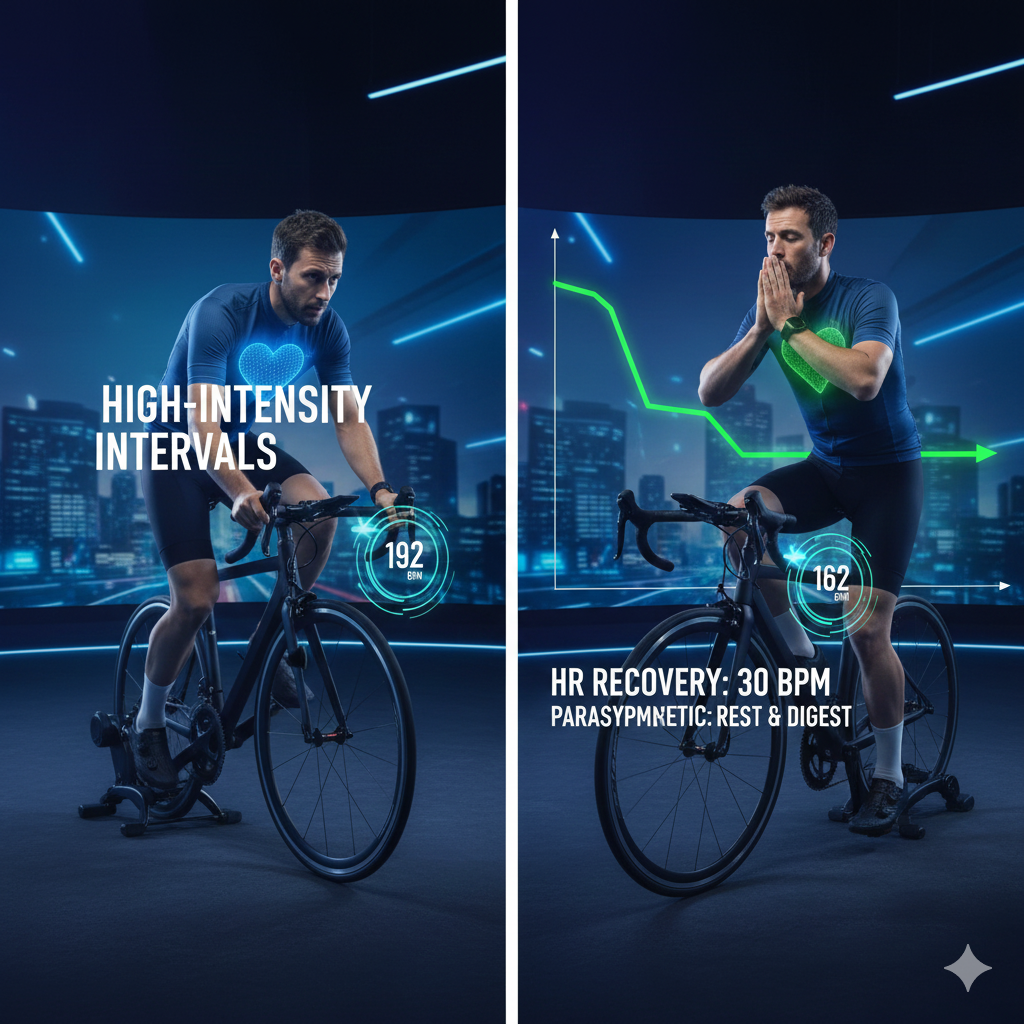
Get Interesteded in HR Recovery
Let’s get you more engaged with your high-intensity intervals! One key metric to focus on is heart rate (HR) recovery after each interval.
HR recovery measures how many beats your heart rate drops in the first 60 seconds after completing a hard interval. This is a reflection of your parasympathetic nervous system, the “rest and digest” system that’s crucial for recovery after exercise and for managing stress in daily life.
How to Measure HR Recovery
Here’s a simple example: after a 3-minute intense interval on the bike, your HR might reach 192 bpm. If you stop or slow to minimal effort, check your HR after 60 seconds—it might be 162 bpm. This gives you a HR recovery score of 30.
The higher the number, the healthier your parasympathetic response and the better your potential performance.
Factors Affecting HR Recovery
If your HR recovery is lower than expected, it could be due to:
- Stress
- Poor sleep
- Poor nutrition
- Inadequate fueling for exercise
When these factors are present, your sympathetic nervous system (fight/flight/freeze) can dominate, reducing HR recovery. If you notice this, it’s a signal to avoid high-intensity sessions temporarily and allow your body to recover.
Even if you feel strong during the interval—hitting the same watts or pace—poor recovery might show as a smaller HR drop, for example only 15 beats in 60 seconds. This happens because short-term poor sleep or nutrition can increase sympathetic drive, temporarily supporting performance but ultimately impairing recovery and longer-term results.
Why Tracking HR Recovery Matters
Tracking HR recovery is not just a number—it’s a window into your body’s recovery capacity and overall health. Persistent poor recovery can increase injury risk, reduce performance, and affect mood.
Take this project on: measure your HR recovery during zone 4 (threshold) and zone 5 (VO2Max) intervals. To make this easier: press the lap button on your watch or bike computer at the start and end of each interval. This will allow you and me to track trends over time and make smarter training decisions.