
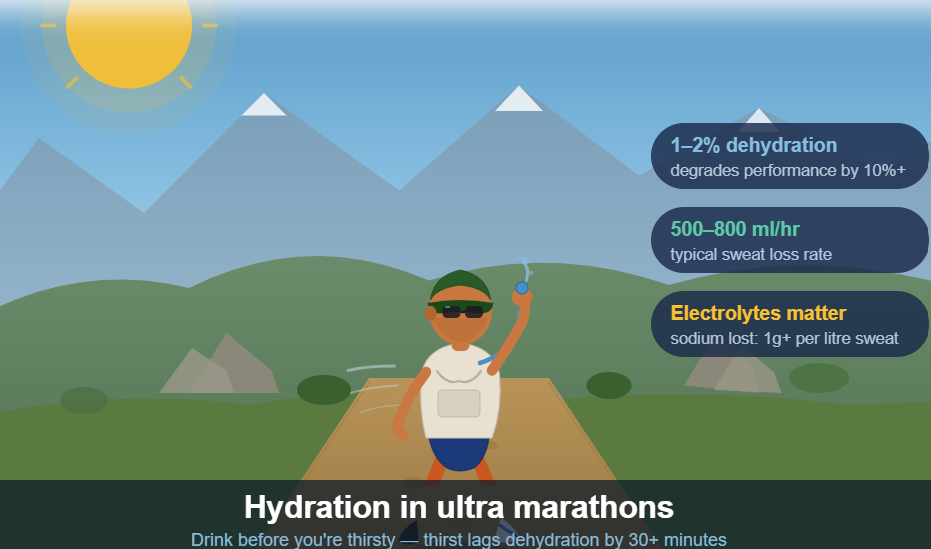
Hydration Strategy for Ultra marathon
Let’s talk about the hydration strategy for an ultra marathon that I completed back in April 2025 in the Sierra Nevada mountains of Southern Spain. I should say at this point, I never put much conscious effort into my hydration during training and races prior to this race. But, when it comes to ultra marathons in the heat and especially your first ultra, the risk of screwing up and adding dehydration to an already difficult physical challenge was much higher than I had experienced before.
About 3 weeks before the event, I carried out a sweat test for a 3hr training run. This means that you weigh yourself before the session and again after. I carried 1 litre of fluid for the run and drank all of it.
The calculations:
I was 70kg when I left the kitchen and 68.5kg when I got back. You then add the 1L of fluid which gives you a 2.5kg loss, i.e 800ml per hour
The temp during the run was roughly 12deg.
The recommendation is to aim for 50-70% replacement of fluids during an ultra. In my training run, I drank 330ml per hour, which works out as a 40% replacement of my hourly total sweat loss.
The temperature was going to fluctuate in Spain as it will be cooler at the beginning of the race (6am) and then get hotter throughout the day before cooling off as we ascended into the higher mountains and towards the finish.
Overall, the aim was to drink 500ml per hour for the predicted 12hours. I set my watch to vibrate every 15mins to prompt me to take three mouthfuls. This amount would hit the 500mls per hour and land me into the recommended 50-70% replacement of sweat loss.
This is where the electrolytes come into play. When you have lost 4-5L of sweat and have been replacing 70% of this loss, supplementing with electrolytes, particularly sodium, becomes important. 4-5L of sweat loss was going to happen at roughly 8-9 hours into the race, but hopefully now you can see that electrolytes are simply not required for marathons and half Ironmans. They are simply not long enough.
The carb powder that I was using for my fluid had sodium in it so I didn’t need to worry about taking on a salt or electrolyte tablet at this point in the race anyways!
This is not an exact science and there can be so many influencing factors such as temperature and work rate but I did however find it helped to have a plan that was somewhat personal to me.
From this point in my training until race day, I made a conscious effort to drink 500ml + of fluids per hour as a form of gut training and preparation for the race.
The result:
My pee never turned yellow all day!
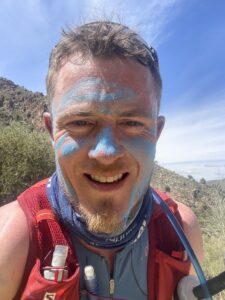
I had two 500ml bottles attached to my run vest and a bladder bag to back me up for the longer sections of the race. It worked a treat.
For those of you about to embark on a big day long event, be prepared and have your hydration strategy ready.
Dehydration and heat are two big reasons why gut issues and nausea happen during long events. Training the stomach to tolerate more fluid to stay hydrated will mean less chance of getting gut issues. Dehydration is hard to get back from on race day.
Right, I’ll leave it there for today. Thanks for reading.
J